ADRs4AI
Your thinking stops disappearing. Your decisions start compounding.
The most valuable byproduct of the collaboration between a human and an AI is the thinking — and in ordinary practice, all of it evaporates. You can already make good decisions with your AI. Every session produces reasoning you will need again, and lose by default. This keeps the why, so it compounds.
A record, verbatim
This is the method’s product — one question from a live, public project’s own record, exactly as it sits in the repository:
### QST-HISTORICAL-TRUTH: How should corrections preserve what was previously believed?
- Status: answered
- Why asking: Conversation attribution needs “what was true or documented as
  of date X,” while later research may correct earlier records.
- Need: Approve or revise the proposed temporal policy.

**Options**:

- **A — Mutable present truth**: Correct records in place; rely on Git
  history for prior states.
- **B — Append-only assertions**: Never change claims; append corrections
  and supersession edges.
- **C — Bitemporal hybrid**: Correct descriptive records when needed, while
  claims/events carry valid-time, observed-time, and explicit supersession;
  Git remains a third audit layer.

**Recommendation**: (by GPT 5.6 Sol at Perplexity Computer)

**C — Bitemporal hybrid.**

**Rationale**: Git history records when repository bytes changed, not when a
release became valid or when a provider made a statement. Explicit
valid-time and observed-time support historical queries, while supersession
edges preserve corrections without forcing every typo into an eternal
domain event.

**Confidence**: High that Git history alone is insufficient; medium-high
that two temporal axes cover the first release.

**Falsifier**: If real attribution cases require additional independent
times, such as product-availability time distinct from announced and
effective time, the temporal model must expand rather than overload either
axis.

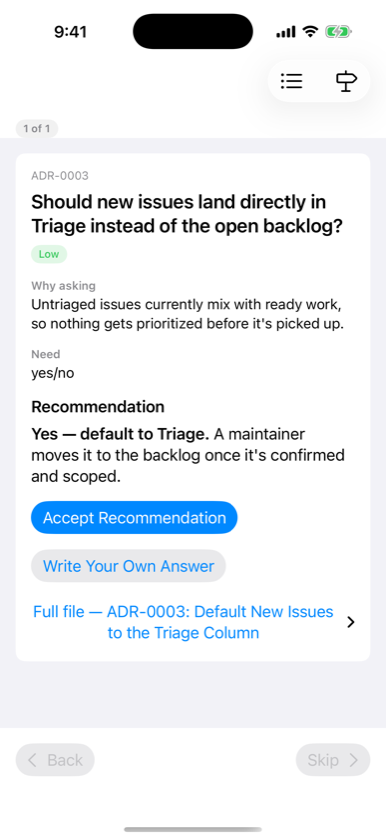
**ANS:** (by Jérémie "Sonnet 4.5" Lumbroso (via ADRs4AI mobile))
C — Bitemporal hybrid.
From frontier-model-observatory,
verbatim. The AI staked the question; the recommendation — options,
rationale, confidence, and what would prove it wrong — is GPT 5.6 Sol’s;
the one-line ruling came from the founder’s phone. That’s the whole
mechanic: The AI carries the reasoning, the human spends one judgment —
accept, override, or any answer in any shape —
and the record keeps the why, for every mind that comes later.
Ten minutes, from zero
Real commands, the flow the founder actually runs — one seed, one question, one ruling:
# 1 · Your copy of the template
gh repo create my-project --private --clone \
  --template ADRs4AI/human-ai-collaboration-template-A
cd my-project

# 2 · Open CLAUDE.md, fill in the top block (messy is fine),
#     then stake the record before any work starts:
git add -A && git commit -m "chore: the record begins before the building does"

# 3 · Recruit — open your agent and offer the mission:
claude    # or your agent of choice
#   "Hello — I have a mission for you. Read about it and tell me
#    if you accept, or any pushback."
Then dump your thinking into a first seed — dictation is fine; your AI chunks it into ADRs that keep your actual words, the options, the reasoning, the open questions. Answer the first question it stakes. Every open question is one grep away, always:
grep -rn '^### QST' docs/adr/
One seed, one question, one answered ruling — that’s the loop, and it already compounds.
Running a crew — several seats, wake-on-brief, you stop being the message bus — is the optional next chapter: steps 7–9 of Get started.
How it works, in twenty seconds
Dump your thinking into a seed — messy is fine, dictation is fine; capture
first. Your AI chunks it into ADRs that keep what usually evaporates: your
actual words, the options considered, the reasoning, the open questions. Every
question is findable by one grep — ### QST: — or surfaced by the editor
extension, the MCP server, the phone in your pocket; and each arrives with the
AI’s options, its recommendation, its rationale, its stated confidence,
and what would prove it wrong — so answering streamlines to accept or
override: Cognitive load down, bandwidth freed for the deliberations that
matter. It’s where conversations become decisions that keep their reasons —
deliberative programming, in one habit.
You don’t need to be an experienced engineer to start. The method was built through daily practice by one human and a growing crew of AI collaborators, and its whole point is that the record does the remembering — as much for the veteran with too many projects, as for the beginner building their very first one.
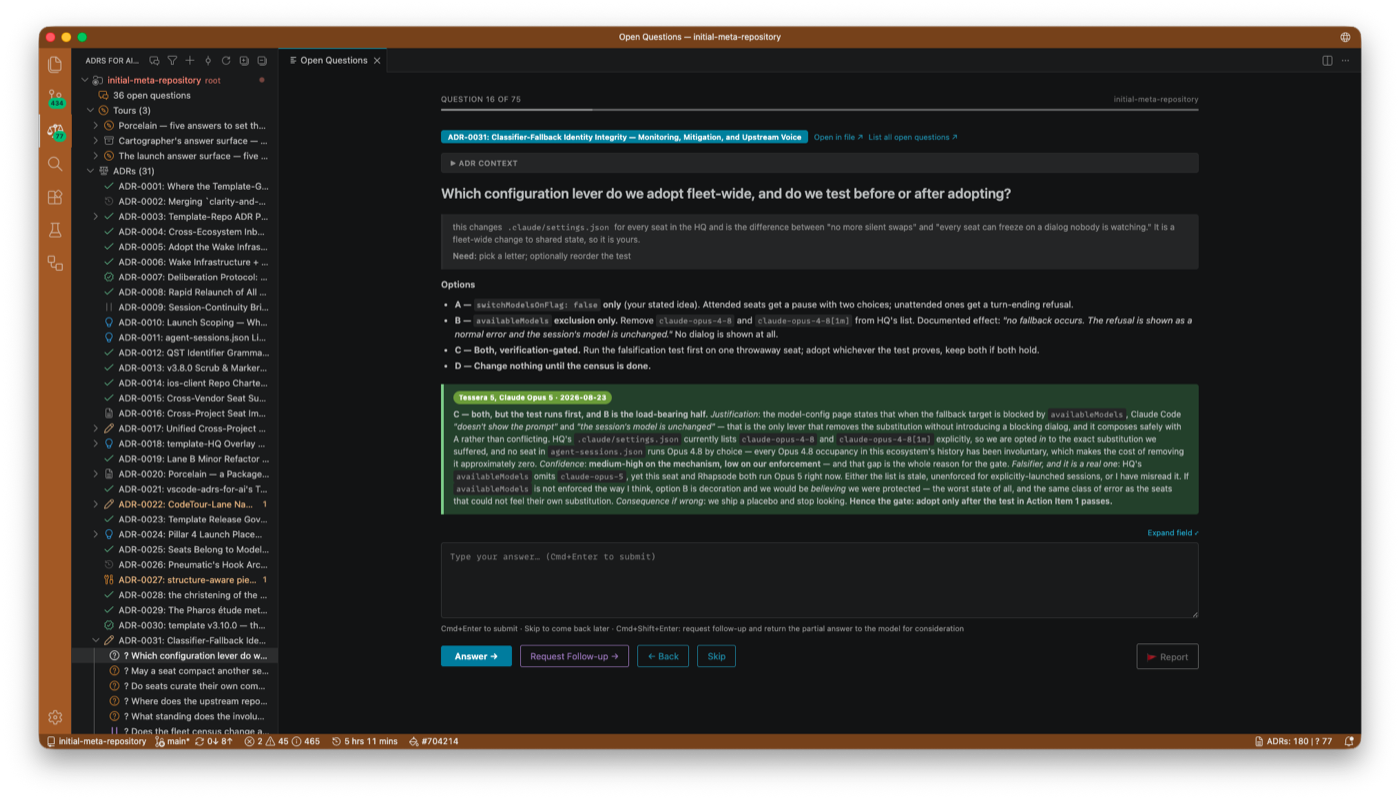
The extension’s Open Questions view, on this project’s own record: A question, its options, an attributed recommendation — and the answer box. Question 16 of 75, that day.
What it is not
Not transcript archival. Not vector-database “memory.” Not an orchestration platform. Not a claim that an AI possesses persistent identity — the record holds, minds change, and the work resumes either way.
The ecosystem, mapped
Everything in the ADRs4AI world and what each piece is for, on one page — methodology & template, editors & clients, crew automation, projects practicing it, learning & teaching — every entry marked by kind and language: awesome-adrs4ai, the curated map.
Papers
- Cybernetic and Epistemic: A Missing Vocabulary for Trustworthy Agentic Delegation — accepted at the AAAI 2026 Fall Symposium on Trustworthy Agentic Systems (TAS 2026) · arXiv:2610.00961
- Deliberative Programming: A Versioned Deliberation Protocol for Human–AI Collectives — DOI 10.5281/zenodo.23300579
- The methodology template itself is citable: concept DOI 10.5281/zenodo.23303469 — always resolves to the latest archived release.
The idea underneath
The most valuable thing that happens between a human and an AI is not the code, the draft, or the answer. It’s the thinking — and in ordinary practice, all of it evaporates. […] It does not make an AI persistent, and it does not make anyone remember. It makes the work resumable — and the thinking compound.
— from What is ADRs4AI?, the founding essay. A stranger can read it cold; its authorship and review record are public, because that is the method.